Hello everyone.
Thank you for visiting our website and for your interest in New York real estate among other real estate investments around the world.My name is Onodera and I am the president of the company.
In this article, I will write about The process and cost of buying real estate (condos and houses) in New York City.
We hope you will bear with us until the end.
Introduction.

Buying real estate in New York City, especially in popular areas such as Manhattan and Brooklyn, is a wonderful dream and at the same time a great investment opportunity.
However, the New York real estate market is complex and has unique rules and conventions.In particular, purchasing a condominium (condominium) requires caution because while the basics are the same, some aspects are different from those of a single-family home.
This article will discuss in detail some of the important aspects of buying a condominium or single-family property in New York City.We will provide comprehensive information on taxes, the length of time it takes to purchase, necessary expenses, and the overall process, all of which are important for those who are considering buying.
New York Real Estate Market Overview
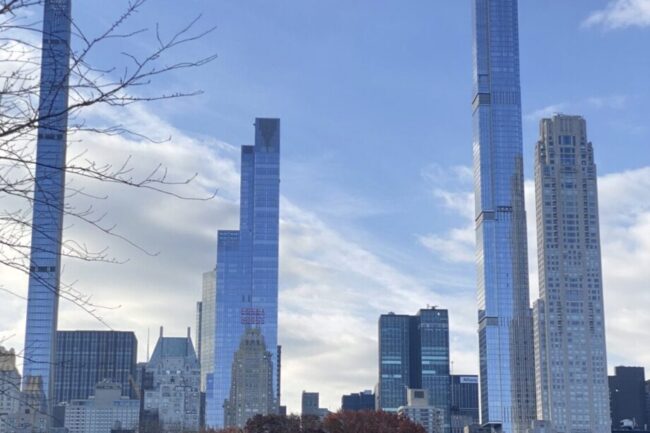
First, let’s briefly touch on the current state of the New York City real estate market: as of 2024, the New York City real estate market is booming.Demand is high and prices are on the rise, especially in Manhattan and Brooklyn.

For example, average condo prices in Manhattan range from about $2,000 to $3,000 per square foot (about 0.093 square meters or 0.028 tsubo).This equates to about $71,420 to $107,130 per square foot (approximately $10,713,000 to $16,069,500).
In other words, a one-bedroom condo of 700 square feet (about 65 square meters, or 19.7 tsubo) would cost around $1.4 million to $2.1 million (about $210 million to $315 million).
In Brooklyn, a similarly sized unit costs around $800,000 to $1.2 million.
However, prices vary widely by region and building characteristics.
*1 USD = 150 yen (as of October 17, 2024)
Flow of Purchasing a Property (Condominium or House)
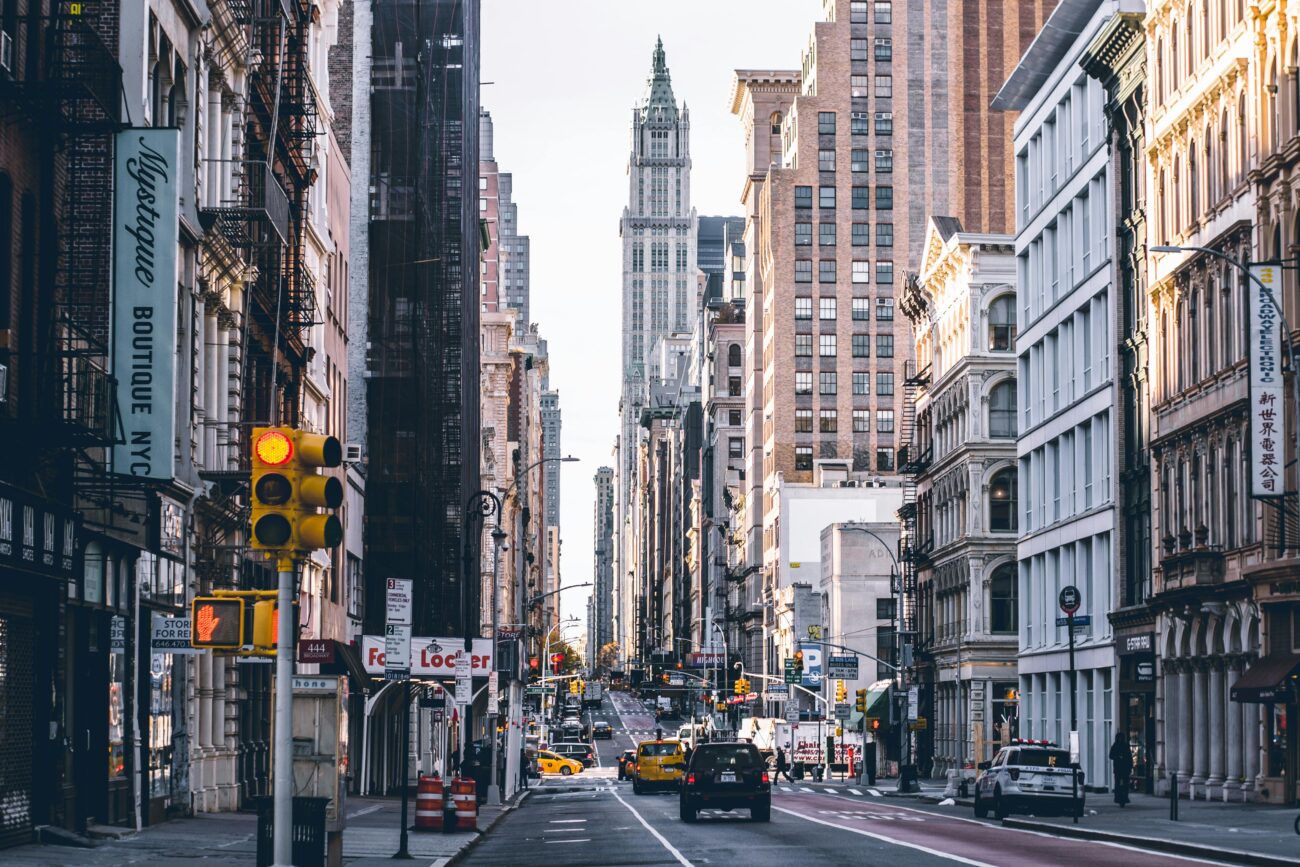
The purchase of a condominium (condo) in New York proceeds as follows.Each step will be explained in detail later.
- Preparation: Establishing a budget, pre-approval for financing
- Property search: contract with real estate agent, property tours
- Offer submission and negotiation
- Execution of purchase agreement
- Due diligence: property survey, financing procedures
- Closing (settlement)
This entire process usually takes about two to three months.However, it can be longer depending on the condition of the property and the speed of response of the parties involved.
Detailed Purchase Process
Let’s take a more detailed look at the process of purchasing a property.
1. preliminary preparations
The first step in purchasing real estate is to accurately assess your financial situation and set a budget.Because of the high cost of real estate in New York City, financing (mortgages) is often the way to go.
If you are considering financing, it is recommended that you consult with your bank or mortgage broker and obtain pre-approval for financing in advance.This will clarify the price range in which you can actually purchase the property and facilitate your property search.
Generally, a down payment of at least 20% of the property price is required.In other words, a $2M ($2,000,000) property requires a minimum down payment of $400,000 ($6,o00,000).However, some new construction properties and certain programs may be available with a 10% down payment.
In addition, many condominiums in New York City are subject to strict scrutiny regarding the financial status of the buyer.In most cases, buyers are required to have liquid assets (funds after purchase) ranging from 10% to 30% of the property value.
2. property search
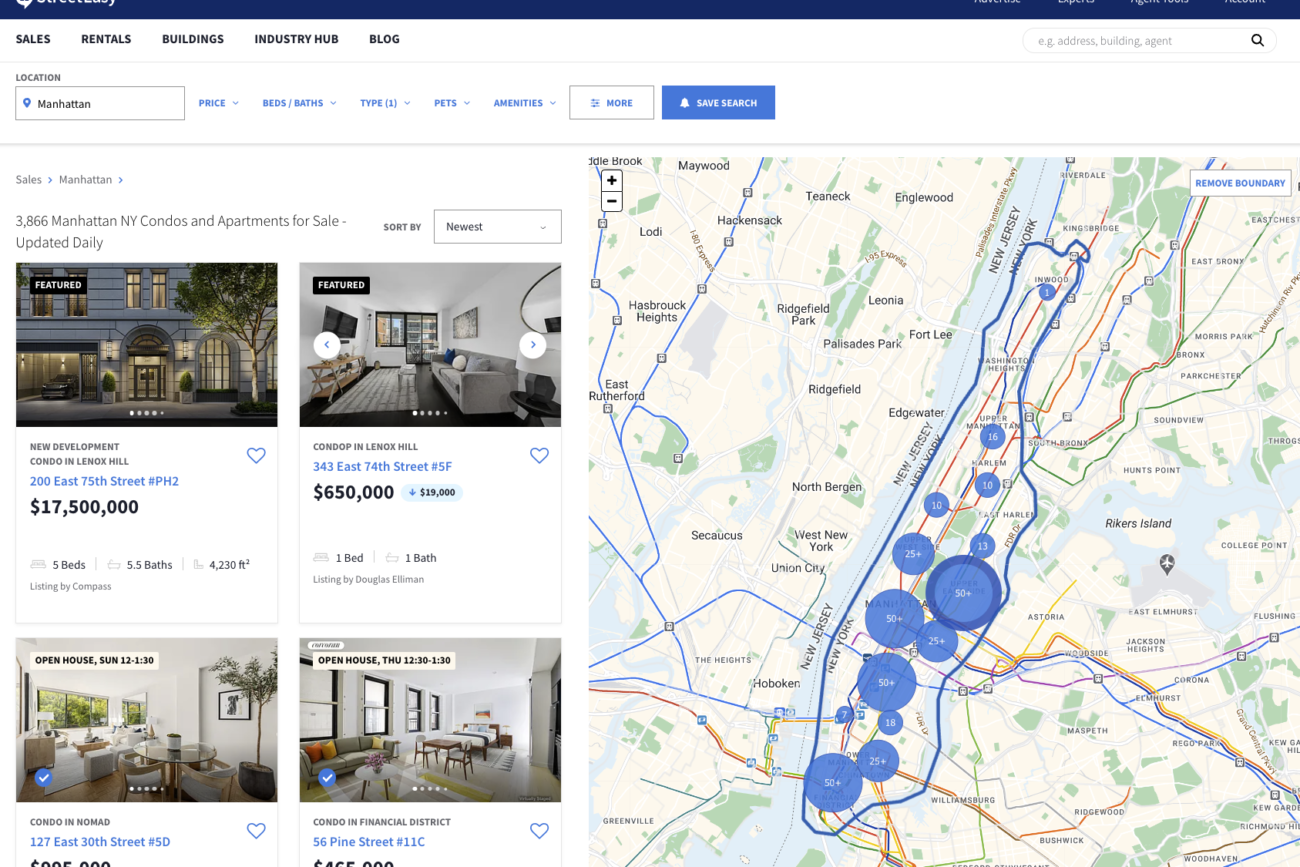
↑There are many properties available on the market.You will need to find the most suitable property from among these.
Once you have decided on a budget, it is time to start the property search phase.The New York real estate market is very competitive, so our agents are here to help you.We research market trends on a daily basis and are also available to assist you with price negotiations and the contract process.
When touring a property, please note the following points
- Overall condition of the building
- Surroundings (transportation, schools, commercial facilities, etc.)
- View
- Sunshine
- Noise level
- Storage space
- Amenities (gym, lounge, rooftop terrace, etc.)
- Management condition
It is also important to check the building’s financial condition and schedule for major repairs.Leave the details to us.
If you are an international inquirer, please contact us and we will be happy to assist you with zooming.
Comparison of NYC Housing Types

There are three main different housing types in the New York City (NYC) real estate market.These are condos, co-ops, and townhouses.
We at Reinvent NY can show you any property on the market in New York City.Our partnerships and connections allow us to support all your real estate investments.
As of October 2024, there are approximately 50,000 homes on the market in New York State, 15,000 in NYC, and 7,500 in Manhattan.Of these in Manhattan, roughly half are condominiums.The following is an explanation of each.
Condo
Features:
– Owners have full ownership of individual units.
– Common areas (lobby, elevators, rooftop, etc.) are owned jointly by all owners.
– The management association (HOA) manages the entire building.
– You pay monthly management fees (common charges).
– The screening process for purchase is not as stringent as co-op.
– There are relatively few restrictions on renting or reselling.
Condos are easy for foreign investors to purchase and are often attractive as investments.Many of the new high-rise residential buildings in Manhattan and Brooklyn are condominiums.
Cooperative (Co-op)
Features:
– Purchases shares in a corporation that owns the entire building.You will be granted the right to use a specific unit.
– There is a rigorous review process (board interview).Thiscould be denied for any reason.
– Strict financial requirements, often requiring you to have liquid assets of 20-50% of the purchase price.
– Monthly maintenance costs include paying off the building mortgage and property taxes.
– There are often restrictions on renting or reselling, and often no renting is possible after purchase until the buyer lives in the property for at least several yearsThis is.
– Prices are generally slightly lower than condos.
Coop properties are limited to New York City residents in most cases, as they must be lived in after purchase.Many older buildings, especially in Manhattan, are co-ops.
Townhouse
Features:
– Typically individual buildings of two to five stories, often sharing a wall with an adjacent building.
– The owner owns both the building and the land outright.
– There is no management association and all maintenance is the responsibility of the owner.
– There is a high degree of privacy and freedom for customization.
– Many buildings have historic value and can be expensive to maintain, but you have control.
This is especially true in Brooklyn, Queens, etc.
We recommend condominiums or townhouses, especially for foreign investors, but we can introduce you to both types of properties according to your needs.
Now, let’s return to the purchase process. 3.
3. offer submission and negotiation

Once you find a property you like, submit an offer.The offer will typically include the following information
- The asking price
- Amount of down payment
- Terms of financing (if available)
- Desired closing date
- Any special conditions (e.g., if you wish to transfer certain furniture or equipment)
Offers are generally submitted in writing and accompanied by “Earnest Money” (good faith money) to be deposited in an escrow account to indicate a serious intent to purchase.The Earnest Money amount is usually around 1% of the asking price.
The seller may be able to make a counter offer to the offer.In this case, the price and conditions are negotiated.
4. conclusion of the sales contract
Once the offer is accepted, the next step is to execute the purchase agreement.In New York, the involvement of attorneys is very important in real estate transactions.The buyer’s and seller’s respective attorneys will draft and review the contract.
The contract typically includes the following
- A detailed description of the property
- Sale Price
- Settlement Date (Closing Date)
- Down Payment Amount
- Terms of the loan (if available)
- Representations and warranties regarding the current condition of the property
- Conditions for termination of the contract
- Areas to be repaired by the seller (if any)
The contract is formalized by signing the contract and depositing the contract deposit (usually about 10% of the sales price) into an escrow account.This contract deposit ultimately becomes part of the down payment.
An important point to note is that the “Caveat Emptor” applies to real estate transactions in New York.In other words, the buyer is basically required to confirm any defects in the property at his/her own risk.Therefore, the next step, due diligence (property inspection), is very important.
5. due diligence

After the contract is signed, a detailed investigation (due diligence) of the property is conducted, usually for a period of 30 days.During this period, the following tasks are performed
- Building Inspection: A professional inspector is hired to conduct a detailed check of the building’s structure, equipment, and interior.The cost is usually around $500 to $1,000 (75,000 to 150,000 yen).If problems are found, they are material for renegotiation with the seller.
- Title Search: Checks to see if there are any problems with the property’s title or if there are any mortgages or other problems.This is usually done by a title insurance company.
- Check the building’s financial condition: Check the management association’s financial statements, minutes, and bylaws in detail.Check the status of the repair reserve fund, schedule for major repairs, and whether there are any lawsuits.
- Financing Procedures: If financing is available, a formal loan application is made during this period.The bank will appraise the property and make a final decision on whether to grant or deny the loan.
- Arranging insurance: Get a quote for property insurance (e.g. fire insurance) and prepare a contract.
If due diligence reveals significant problems, you can terminate the contract or renegotiate the terms.For example, if unexpected repairs are found to be necessary, the purchase price may be reduced or the seller may be required to perform the repairs.
6. closing (settlement)

Once everything is in place and the financing has been approved, it is time for the closing.The closing is usually held at the title company or attorney’s office.
The following parties will be present at the closing
- The buyer and his/her attorney
- Sellers and their lawyers
- Real estate brokers
- Title company representative
- Bank representative (if financing is used)
At closing, the following procedures will take place
- Final document review and signature
- Payment of remaining balance
- Delivery of property keys and related documents
The closing typically takes about 2-3 hours.
It is important to note that a final check of the property (final walk-through) is usually conducted just prior to closing.This is to ensure that the property is maintained in the condition it was in when the contract was signed and that the promised repairs have been made.
The attorney will also provide a detailed statement of the amount required at closing in advance.Typically, you will be asked to pay by bank check (Cashiers check).
We will now look at the expenses that will be incurred.
Taxes and Other Expenses
When purchasing real estate in New York, there are several taxes to consider.The main ones are as follows
1. property tax
New York City property taxes are among the highest in the nation.The tax rate is based on the assessed value of the property, typically ranging from about 0.9% to 1.2% of the assessed value per year for a condominium.
For example, for a condominium valued at $1.5 million, annual property taxes would be in the range of $13,500 to $18,000 (approximately ¥2,025,000 to ¥2.7 million).
However, tax abatement programs (e.g., 421-a tax abatement) may apply to newly constructed or extensively renovated properties.In this case, taxes may be substantially reduced for the first few years.
Mansion Tax
This tax is applicable to condominiums.This tax is specific to New York State and applies to residential purchases of $1 million or more.The tax rate increases in stages depending on the purchase price:
- 1 million to less than $1.5 million: 1%.
- More than $1.5 million but less than $2 million: 1.25
- More than $2 million but less than $2.5 million: 1.5
- More than $2.5 million but less than $3 million: 2.25
- 3.25%: $3 million to $5 million
- More than $5 million but less than $10 million: 3.5
- More than $10 million but less than $15 million: 3.75
- More than $15 million but less than $25 million: 3.9
- Over $25 million: 3.9%.
For example, if you purchase a condominium worth $2 million, the condominium tax would be $25,000 (approx. ¥3.75 million).
3. transfer tax
This tax is paid by the seller, but is often actually paid by the buyer as part of the purchase price.It is payable to both New York State and New York City.
- New York State Transfer Tax: 0.4% (0.65% for properties over $1,000,000)
- New York City transfer tax: 1% (1.425% for properties over $500,000)
For a $2,000,000 property, the total transfer tax is $41,500 (approximately $6,225,000). 4.
4. common charges and maintenance fees
These are not strictly speaking taxes, but are fees that condominium owners are required to pay each month.They are used to maintain the common areas of the building, security, and amenity operations.
The amount varies widely from building to building, but generally ranges from $1 to $2 per square foot (approximately 0.093 square meters or 0.028 square feet) per month.In other words, a 1,000-square-foot unit would cost $1,000 to $2,000 per month (approximately ¥150,000 to ¥300,000).
Prices will vary depending on the condominium.
Attorney Fees

In real estate transactions in New York, it is common for the buyer’s side to hire an attorney.The attorney plays an important role in reviewing the contract, negotiating, verifying title (ownership), and witnessing the closing.
Attorney fees vary depending on the price of the property and the complexity of the transaction, but generally range from
- Standard transactions: $2,500 to $5,000 (approximately 375,000 to 750,000 yen)
- Complex transactions and high value properties: $5,000 to $10,000 (approximately 750,000 to 1.5 million yen) or more
When choosing an attorney, it is important to select an experienced attorney who is familiar with real estate transactions in New York.Choose one based on reputation and expertise, as well as low cost.
Other Costs
When purchasing a property, there are several other costs in addition to those listed above.The main ones are as follows
- Real estate brokerage fee: This is very different from Japan, where the seller usually pays everything (3% each, 50-50).This is a big difference from Japan.) However, this is customary and can vary depending on market conditions.Typically, it is 5% to 6% of the sale price.
- Title Insurance: This insurance ensures that there are no problems with ownership.It costs about 0.4% to 0.5% of the property value.For example, for a $2 million property, it is about $8,000 to $10,000 (about $1.2 million to $1.5 million).
- Mortgage Registration Tax: A tax on the use of financing, about 2% of the loan amount; for a $1 million loan, this would be about $20,000 (about $3 million).
- Appraisal fees: around $500 to $1,000 (75,000 to 150,000 yen).
- Building inspection fee: Approximately $500 to $1,000 (75,000 to 150,000 yen).
- Escrow Deposit: An advance payment of property taxes and insurance, usually two to three months’ worth.
In total, you should expect to pay an additional 2% to 5% of the property price for these fees.
Points to Consider After Purchase

After purchasing a property, there are several things to keep in mind.Some examples are listed here.
- Property Tax Review: In New York City, property tax assessments for the following year (beginning July 1) are published annually on January 5.If you are dissatisfied with the assessed value, you may file a Tax Appeal by March 1.A Tax Appeal is worth considering, especially if there is a significant discrepancy between the purchase price and the assessed value.
- Management Association Participation: For condominiums, it is important to participate in the general meetings of the management association and be involved in the management of the building.You can be involved in important decisions such as major repairs and budget decisions.
- Caution when remodeling: When remodeling a property, you must always obtain approval from the management association.There may be severe restrictions, especially for large-scale work such as changing the water supply or moving walls.
- Restrictions on renting: When renting a property after purchasing it, there may be restrictions in the management association’s rules.Many buildings prohibit short-term rentals (e.g. Airbnb), so you need to check in advance.However, some hotel condos allow Airbnb on a monthly basis, so you can expect a high yield.We have many properties that we are connected with, so please contact us for more details.
- Property Tax Abatement Programs: New York City has several property tax abatement programs.For example, there is the “STAR” program, which applies to those who use the property as their primary residence.If you meet the requirements, you may be able to reduce your tax burden by applying for this program.
Conclusion

Buying a condominium (condo) in New York City, especially in Manhattan and Brooklyn, is a complex and time-consuming process.However, with proper preparation and the support of our agents, the process can go smoothly.
We recommend that you keep the following points in particular in mind when making your purchase.
- Set an appropriate budget: Consider not only the property price, but also the total cost, including taxes and other expenses.
- Partnering with a Trusted Professional: Finding an experienced real estate agent, attorney, or mortgage broker is key to a smooth transaction.
- Thorough Due Diligence: It is important to carefully investigate all aspects of the property, including its condition, the financial condition of the building, and the surrounding environment.
- Long-term perspective: Real estate is a long-term investment.Consider future price appreciation potential, lifestyle changes, etc. when making your selection.
- Understand Costs: It is important to have a clear understanding of ongoing costs after purchase, such as property taxes and maintenance fees, and to make a long-term financial plan.
New York real estate, especially condominiums, is an attractive asset that attracts attention from around the world.With the right information and preparation, you can have a great home and investment opportunity.We hope this guide will assist you in your New York real estate purchase.
Thank you for taking the time to read this article.
New York was the center of the world 100 years ago, is still the center of the world today, and will remain so 100 years from now.We hope you understand that investing in real estate in such New York City has the potential to bring great value.
Our company, Reinvent NY Inc, continues to support individuals and companies entering or moving to the United States in 2019 and offers comprehensive services to support all aspects of New York real estate investment.
We would be happy to discuss your needs with you once by filling out the form below.
If you are considering immigrating to the U.S., have a small investment amount, or have no track record or history in the U.S., please contact us with any questions you may have.We promise to provide you with a friendly and sincere service.More details are below.